

Compound Footwear’s Alex Witty on transforming waste motorsport tyres into recycled and sustainable shoes
It often takes a eureka moment. Alex Witty’s came during lockdown from COVID-19, albeit on the other side of the world from his university in Brighton. Having spent the previous year working on a footwear project where he’d learned about the sneaker market and the vast volumes of waste it generates, he saw the Australian Formula 1 Grand Prix had been cancelled. With that came the revelation that 1,800 racing tyres were to be sent back to the UK for incineration without ever having touched the track. Digging further, Witty discovered that most motorsport tyres are burned as waste after each race.
“There was one question going round my head: ‘can I use the waste rubber from these tyres to replace that which is used in footwear,” he says, of the lightbulb moment. Witty was studying Sustainable Product Design at the University of Brighton at the time. During previous project work on footwear and sneakers, he’d already set his sights on addressing the waste and emissions caused by the industry but, up to that moment, didn’t have a firm idea of how.
“The next thing I know, it was time to submit ideas for our final year project and the concept of Compound Footwear, was formed,” he explains. “My father had worked for Tolemans F1, a Formula One team that was active in the early 1980s. I spoke with some of his former colleagues and found out just how rife the motorsport industry is – it lit the touchpaper and sent me down the rabbit hole of wanting to revolutionise both the motorsport and footwear industries’ approaches to sustainability.”
Fast-fashion and tyre waste
Compound Footwear uses waste motorsport tyres, eco-leather, and recycled materials to create a unique, recyclable solution to the environmental pollution generated by fast fashion and tyre waste. Twenty-five billion pairs of shoes are manufactured each year globally using virgin materials. They are difficult to recycle because of their complex design and the number of materials used. As a result, 22 billion pairs end up in landfill, where they release harmful chemicals into the soil and groundwater and contribute to global health and waste management crises.
“Shoe production releases as much CO2 into the atmosphere each year as the emissions of 66 million cars,” Witty states. “That’s a carbon footprint that accounts for 20% of the world’s fashion waste, which produces 10% of all global CO2 emissions – more than all maritime shipping and international flights combined. It’s an unsustainable waste crisis that’s only likely to grow as the sneaker industry grows.”
It’s a similar story for the waste generated from tyres. According to Witty, two billion tyres are produced annually, the equivalent of five million each day, and one billion reach the end of their life every year.
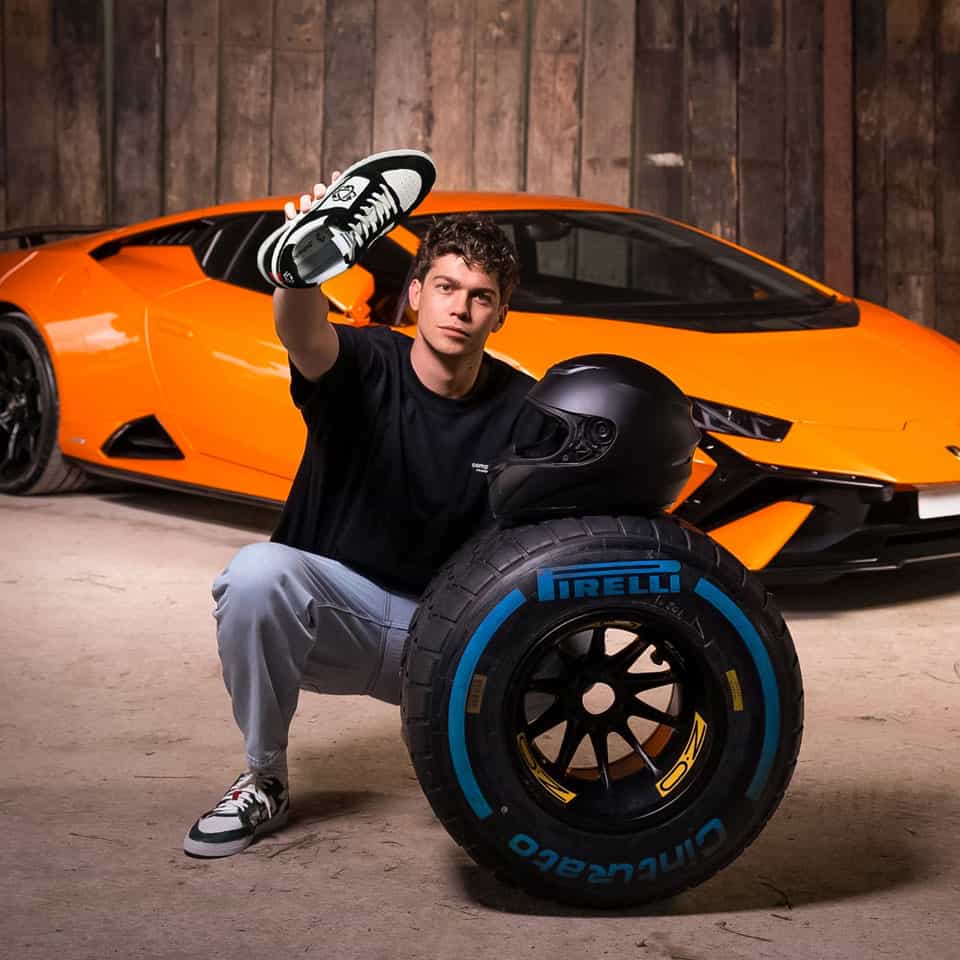
“Motorsport, including Formula 1, rallying, and Indycar, consumes more than 600,000 tyres in a single season, most of which become waste after each race. Sometimes, they’re waste after just a few laps,” he says. “Formula 1 alone discards 70,000 tyres annually. They’re sent to the UK to concrete factories to be incinerated as an alternative source of fuel. By using the rubber left on these tyres after race day, we can prevent the use and demand for virgin rubber and reduce the carbon-intensive process it requires. We’re also providing motorsport with a sustainable alternative for disposal, and a new revenue stream to support its growing merchandise sales.”
Circular design inspiration
Witty is passionate about the role of design in creating products that incorporate sustainable or circular principles; designers, he says, have a responsibility to create products that are desirable and to fix problems, not cause them. “The onus of environmental protection and sustainability shouldn’t necessarily be on the consumer,” he says. “I’ve always had a passion for the subject. My mother worked as a producer/director at the BBC’s Natural History Unit, hearing her incredible stories of the wonders of the natural world and listening to riveting stories from Sir David Attenborough gave me a real understanding of the importance of preserving the natural environment, conservation, and exploration.
“Studying in Brighton let me put this passion into practice,” Witty adds. “My Professor Gareth Owen Lloyd instilled his vision for distributed design in all his students and taught us the importance of our role in designing sustainably and responsibly. It’s a mentality I wish more designers would adopt instead of thinking about the short-term life of their product – when providing a service or product for consumers, it’s our responsibility to design it with the full lifecycle in mind.”

Sneakers from recycled tyres
With this mindset, Witty has worked through an extensive product concept and development process over the last couple of years. It began, he concedes, in relatively humble fashion. “It was just me watching how to build shoes on YouTube and experimenting by creating sneakers from foam and cardboard. I was also inspired by Helen Kirkum and Nicole McLaughlin, who have created incredible footwear and fashion garments from waste. The initial basic approach continued with me buying a sewing machine and learning how to stitch fabric pieces together from old waste race suit material that I’d bought second hand.”
Having gauged initial interest and viability, Witty visited several tyre recycling factories. Here, he learned about the recycling process and sourced some pure rubber powder, with which he could test different compound mixtures of recycled race tyre rubber and recycled natural rubber from old shoes to hone the perfect balance for a sneaker. He has also worked with the University of Brighton’s material/chemical science team, and with material scientists and race series organisers, including from Formula 1 and Formula E.
To date, Witty’s ‘sneaker journey’ has taken him around the world, including to shoe-making courses, meetings, and collaborative sessions with world-leading industry experts in Bahrain, Italy, Spain, Germany, and Portugal. As well as working on recycle tyre rubber, he has also investigated polyester recycling techniques to create new yarns from waste motorsport clothing to create sneaker uppers – typically, 25% of source materials from motorsport waste like race suits, clothing and carbon fiber go to waste as factory off-cuts.
“Motorsport, including Formula 1, rallying, and Indycar, consumes more than 600,000 tyres in a season, most of which become waste after each race. Sometimes, after just a few laps”
— Alex Witty, Compound Footwear
Future footwear
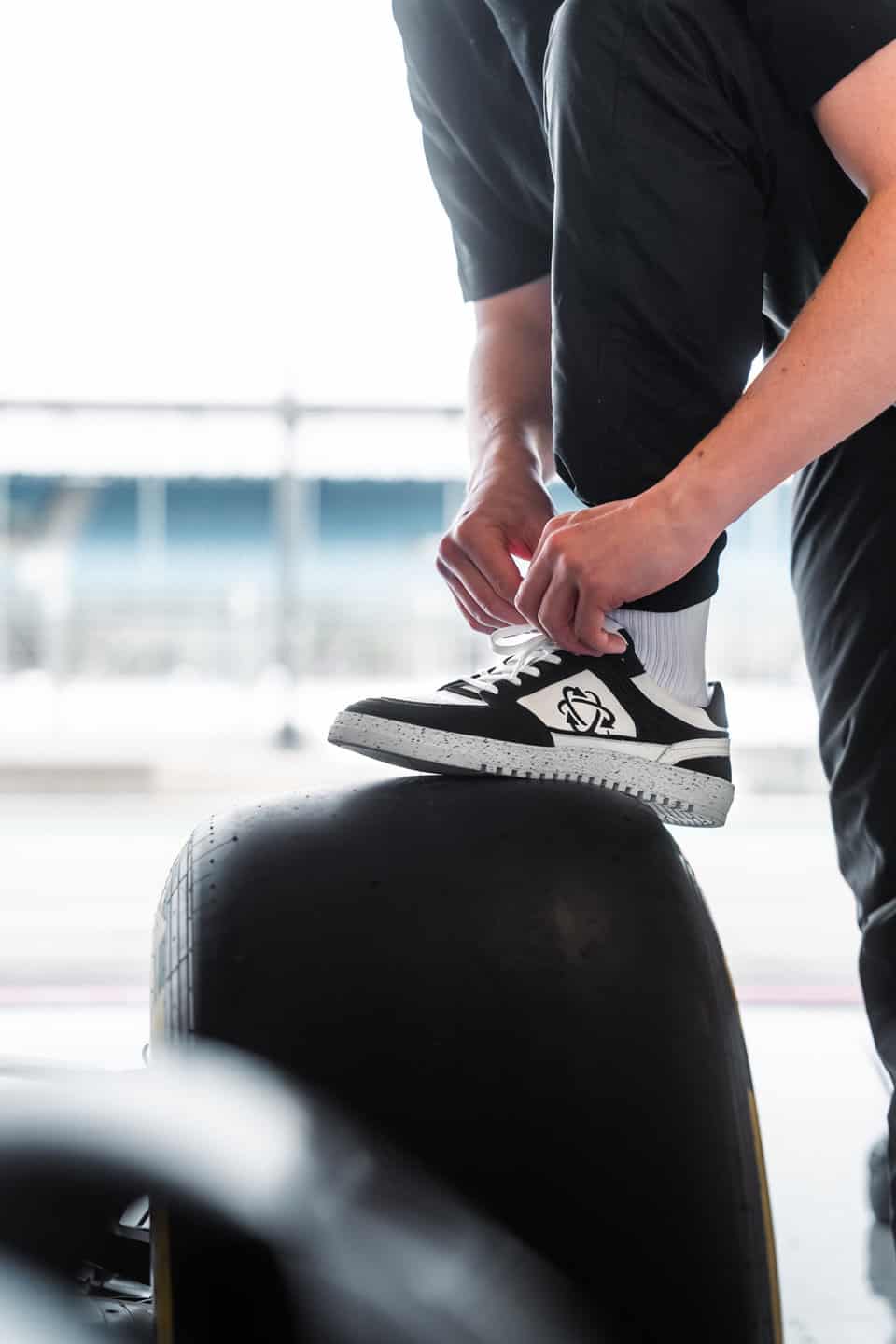
Heritage, Compound Footwear’s maiden sneaker, is created using recycled race tyre rubber, recycled natural rubber, eco-leather, and other recycled materials. A patented process combines the race tyre and natural rubber to create the sole of the shoes, the uppers are made from waste leather and recycled polyester lining and laces.
At the end of their natural life, the sneakers can be recycled into 100% reusable raw materials to make new shoes and products through the company’s Eco Deposit System, which incentivises customers to return worn-out shoes. This kind of customer engagement and collective responsibility is a key thread to Witty’s work. “I learned through my own experiences that people don’t like being preached to or shamed into making decisions, it really has a negative impact on what is principally a positive message.
“That’s always made me want to make sustainability sexy or desirable, not just a buzzword or a company’s USP,” he adds. “We’re doing a great job for the planet but, equally, we create footwear with a story and an origin that’s entirely unique, interesting, and good for us all. That’s a very important principle for me.”
This principle has brought Compound Footwear important recognition and support from the motorsport world. It has also received funding from organisations including Innovate UK, Santander, and Verizon. Next, says Witty, is expansion and growth while also looking for new ways of incorporating even more recycled tyre rubber into products.
“We’re still a small startup with limited resources and a small core team that’s working tirelessly day in, day out,” he says. “We’re currently live on Kickstarter as we look to get our first ever range of recycled motorsport sneakers onto the feet of our community. Ultimately, though, we want what we do to me more than just a nice story. Our vision is to avoid the use of virgin fossil fuels, reduce the number of different materials that make most sneakers unrecyclable, and incorporate sustainable and recycled materials that not only reduce environmental impact, but are an attractive step towards a cleaner, greener future.”